2026 Military PCS Weight Allowances by Rank
Household goods weight allowances under JTR Table 5-37 of the Joint Travel Regulations, effective 1 January 2026. Two things set your figure: your pay grade, and whether your dependents relocate with you. The table below covers every grade the six branches use — Army, Navy, Air Force, Marine Corps, Space Force and Coast Guard — with and without dependents.
Rates last verified August 2026 against the published source tables.
An O-4 with dependents is authorized 17,000 lb, and 14,000 lb without. The highest allowance in the table is 18,000 lb, which O-6 receives whether or not dependents relocate — a grade above the O-4 figure the two are most often confused for.
Weights are in pounds and describe the full PCS allowance. Professional books, papers and equipment — PBP&E, JTR par. 051304 — is authorized on top of these figures rather than inside them, provided it is weighed and itemized separately at pack-out. Going over your allowance is not a penalty: the government moves the authorized weight and bills you the commercial rate for the excess, computed from the origin and destination weigh tickets.
E-1 to E-3 weight allowance
E-1: 8,000 lb with dependents, 5,000 lb without. E-2: 8,000 lb with dependents, 5,000 lb without. E-3: 8,000 lb with dependents, 5,000 lb without.
Professional books, papers and equipment are on top of these figures — up to 2,000 lb for the member and 500 lb for a spouse if approved — and so is an empty gun safe up to 500 lb. Unaccompanied baggage is not: it comes out of the allowance.
E-4 weight allowance
E-4: 8,000 lb with dependents, 7,000 lb without.
Professional books, papers and equipment are on top of these figures — up to 2,000 lb for the member and 500 lb for a spouse if approved — and so is an empty gun safe up to 500 lb. Unaccompanied baggage is not: it comes out of the allowance.
E-5 weight allowance
E-5: 9,000 lb with dependents, 7,000 lb without.
Professional books, papers and equipment are on top of these figures — up to 2,000 lb for the member and 500 lb for a spouse if approved — and so is an empty gun safe up to 500 lb. Unaccompanied baggage is not: it comes out of the allowance.
E-6 weight allowance
E-6: 11,000 lb with dependents, 8,000 lb without.
Professional books, papers and equipment are on top of these figures — up to 2,000 lb for the member and 500 lb for a spouse if approved — and so is an empty gun safe up to 500 lb. Unaccompanied baggage is not: it comes out of the allowance.
E-7 weight allowance
E-7: 13,000 lb with dependents, 11,000 lb without.
Professional books, papers and equipment are on top of these figures — up to 2,000 lb for the member and 500 lb for a spouse if approved — and so is an empty gun safe up to 500 lb. Unaccompanied baggage is not: it comes out of the allowance.
E-8 weight allowance
E-8: 14,000 lb with dependents, 12,000 lb without.
Professional books, papers and equipment are on top of these figures — up to 2,000 lb for the member and 500 lb for a spouse if approved — and so is an empty gun safe up to 500 lb. Unaccompanied baggage is not: it comes out of the allowance.
E-9 weight allowance
E-9: 15,000 lb with dependents, 13,000 lb without.
Professional books, papers and equipment are on top of these figures — up to 2,000 lb for the member and 500 lb for a spouse if approved — and so is an empty gun safe up to 500 lb. Unaccompanied baggage is not: it comes out of the allowance.
W-1 to W-5 weight allowance
W-1: 12,000 lb with dependents, 10,000 lb without. W-2: 13,500 lb with dependents, 12,500 lb without. W-3: 14,500 lb with dependents, 13,000 lb without. W-4: 17,000 lb with dependents, 14,000 lb without. W-5: 17,500 lb with dependents, 16,000 lb without.
Professional books, papers and equipment are on top of these figures — up to 2,000 lb for the member and 500 lb for a spouse if approved — and so is an empty gun safe up to 500 lb. Unaccompanied baggage is not: it comes out of the allowance.
O-1 to O-3 weight allowance
O-1: 12,000 lb with dependents, 10,000 lb without. O-2: 13,500 lb with dependents, 12,500 lb without. O-3: 14,500 lb with dependents, 13,000 lb without.
Professional books, papers and equipment are on top of these figures — up to 2,000 lb for the member and 500 lb for a spouse if approved — and so is an empty gun safe up to 500 lb. Unaccompanied baggage is not: it comes out of the allowance.
O-4 to O-6 weight allowance
O-4: 17,000 lb with dependents, 14,000 lb without. O-5: 17,500 lb with dependents, 16,000 lb without. O-6: 18,000 lb, with or without dependents.
Professional books, papers and equipment are on top of these figures — up to 2,000 lb for the member and 500 lb for a spouse if approved — and so is an empty gun safe up to 500 lb. Unaccompanied baggage is not: it comes out of the allowance.
O-7 and above, and the senior enlisted advisors
General and flag officers share the O-6 allowance of 18,000 lb, with or without dependents. The Senior Enlisted Advisor to the Chairman and the senior enlisted leader of each Service are authorized more than the E-9 row for the rest of their careers; JTR Table 5-37 names them.
What counts as household goods
JTR par. 051301 authorizes transportation of household goods — the furniture, clothing, appliances and personal effects of a member and their dependents — up to the weight in JTR Table 5-37, on a PCS order. The allowance is set by pay grade and by whether dependents relocate; it does not scale with how many dependents you have, and it is the same for every branch.
What is not household goods. Carriers will not accept hazardous materials (propane, paint, aerosols, ammunition and other flammables), perishable or opened food, or most plants, which quarantine rules stop at some state lines. Vehicles ship under their own entitlement, not as household goods. Par. 051305 lists the situations with no authority for a household-goods shipment at all — a Reserve Component member called to active duty for under 20 weeks, a member on leave or absent without leave, among others.
Pro-gear: 2,000 lb, and 500 lb for a spouse
Professional books, papers and equipment — PBP&E, JTR par. 051304-A — ship on top of the allowance, not inside it, up to 2,000 lb net. The member certifies they are necessary for duty at the next station, and they must be declared at origin and weighed and listed separately on the inventory, or they count as ordinary household goods. The ceiling cannot be waived for a CONUS move.
Spouse pro-gear needs approval. A spouse's professional gear is authorized only through the Secretarial Process, and if approved is limited to 500 lb. The condition is part of the entitlement: the figure means nothing without the approval.
Gun safes: 500 lb on top of the allowance
JTR par. 051304-C authorizes an empty gun safe with the household goods, up to 500 lb net in addition to the JTR Table 5-37 allowance — but the allowance plus the safe may not exceed 18,000 lb. Like pro-gear it must be declared at origin and documented under the Service's transportation procedures, and it travels the same way and to the same places as household goods. Firearms themselves are subject to par. 051303.
Required medical equipment
Medical equipment a Uniformed Services healthcare provider certifies as necessary for the treatment of the member, or of a dependent authorized medical care, ships in addition to the allowance under JTR par. 051304-B. The certification is what makes it an entitlement rather than a heavy piece of household goods.
Unaccompanied baggage comes out of the allowance
Unaccompanied baggage — the smaller, faster shipment of what you need before the main one arrives — is part of the household-goods weight allowance, not an addition to it (JTR par. 051403-A), and par. 051401-A counts the allowance as the combined weight of the main shipment, the unaccompanied baggage and anything in storage.
A separate cap applies only where the new PDS carries an administrative HHG weight limit, which JTR par. 051402-A-1 provides for only at a PDS OCONUS. There the baggage counts inside the location's administrative limit (par. 051403-A), and is itself capped at the lesser of that location's published figure and 2,000 lb for a member with command-sponsored family members — for the whole family, not each traveler — 10% of the weight allowance for an unaccompanied member normally assigned to furnished government quarters, or 2,000 lb for an unaccompanied member not normally assigned to furnished bachelor quarters.
Separately, par. 051403-B limits unaccompanied baggage carried by commercial air to 1,000 lb including any pro-gear. Weight over that is not lost — it moves by regular transportation methods.
How the weight is measured
Net weight is what counts, and JTR par. 051404 and Table 5-39 say how it is found: the loaded vehicle is weighed (gross), the empty vehicle is weighed (tare), and the difference is the shipment. Certified scales, two tickets, and both are documents you should hold copies of — a government move produces them through the carrier, and a personally procured move requires you to obtain them yourself at a certified scale, because the incentive is paid on those tickets.
Estimate before the truck arrives. Have the movers survey the house before pack-out and give you a weight estimate. If it is close to the allowance, decide before moving day what stays: heavy furniture sold before a move is often cheaper than the overage to ship it, and the room-by-room figures on this page are for exactly that decision.
You can ask for a reweigh — before delivery. If the weight on the tickets looks wrong, you may request a reweigh, and the request has to reach the transportation office before the shipment is delivered and unloaded — once it is off the truck the tare can no longer be established. Ask in writing, and ask early: the whole excess charge is prorated on this figure, so a tare taken with the crew's equipment still aboard is not a rounding error, it is the bill. The reweighed figure is the one that counts, whichever way it moves.
OCONUS consumables, and storage
At an overseas station on the consumable-goods list, a member is authorized a consumable-goods shipment in addition to the household-goods allowance — a fixed number of pounds per location, moved the same way as household goods. Storage in transit (JTR par. 052404) holds goods that cannot be delivered when they arrive, and non-temporary storage keeps what the order does not authorize you to take; both are entitlements with their own limits rather than extra weight.
Going over: what the excess costs
The Government pays the carrier for the whole shipment and collects the cost of the excess from you (JTR par. 051306). JTR par. 051306-D sets the price: the excess is prorated on the cost of the total net weight transported. 500 lb over on a 9,500 lb shipment is 5.3% of the shipment's cost — at the rate the Government actually paid on your lane, not a flat rate per pound and not a penalty on top of it.
This page can price it. Every other page tells you to ask your transportation office. The estimator on this page prices the shipment on the 400NG tariff for your origin and destination — the same engine behind the PPM figure on the calculator — and applies the rule to it, so the answer is a dollar range for your lane rather than a shrug. The tariff is domestic; for an overseas move the international rate is the transportation office's to quote.
How it actually reaches you. Nothing is asked of you on moving day. The carrier bills the Government, the transportation office computes the excess against your allowance once the weight tickets are in, and what you owe becomes a debt collected out of your pay — which is why the bill often arrives months after the move, against a paycheck you had already spent. You should receive the computation showing the net weight, your allowance and the rate applied; check it against your own copies of the tickets, because a reweigh is no longer available by then and the arithmetic is the only thing left to dispute. Ask about installments rather than one deduction if the figure is large.
High-value items, and what to leave behind
Items worth more than about $100 per pound are high-value under the carriers' inventory rules and belong on a high-value inventory before pack-out: undeclared, the carrier's liability for such an item is limited by weight rather than value. Appraise anything near the threshold, keep the paperwork, and consider a rider on your own insurance for the move.
Leave behind what you would not buy again. Weight you do not ship is money in a PPM and money saved in a government move. Books, tools, a freezer's contents and the exercise equipment you have not used since the last PCS are the usual suspects.
The PPM weight strategy
In a personally procured move (JTR par. 051502) the incentive is paid on the constructed cost of the weight you actually ship, up to your allowance — the lesser of the two. Authorized 9,000 lb and shipping 6,000 means a 6,000 lb incentive. So the strategy is to ship as close to the allowance as you can without going over it, with pro-gear weighed and declared separately so it is paid for and not counted against you.
Figures are from JTR Table 5-37 of the Joint Travel Regulations, effective 1 January 2026. Your transportation office applies the order; this page applies the regulation.
When there is nothing to pay, and nothing to gain
Under the allowance, nothing is owed and nothing is added. Coming in light costs you nothing and pays you nothing — there is no bonus for shipping less than you are entitled to. What it does buy is room for the estimate to be wrong, which on a shipment weighed after pack-out is worth having.
Pro-gear does not count against you, if it is declared. Professional books, papers and equipment are weighed and allowed on top of the household goods allowance. Undeclared, they are simply weight — and the declaration has to happen at pack-out, in front of the crew, not on the voucher afterwards.
The allowance does not change with the distance. It is set by pay grade and dependency status alone. A move across town and a move across the country are entitled to the same weight, which is why the excess-weight charge varies so much with the lane while the allowance does not.
How the weight is proved
Certified scales, twice, per vehicle. A weight ticket is only evidence if it is empty and full, from a certified scale, for each vehicle or truck used. One ticket proves nothing, and an uncertified scale is the most common reason a settlement is sent back — which costs weeks rather than money.
On a government move, the weight is theirs to record. The carrier weighs the shipment and the transportation office receives the figure. You are entitled to see it, and to request a reweigh if it looks wrong — but the request has a window, so query it when the number arrives rather than when the bill does.
Excess weight is billed, not deducted. Going over is recovered from your pay, prorated on the cost of the whole shipment. Your transportation office can tell you what your particular lane prices at before you pack, which is the one moment the number is still changeable.
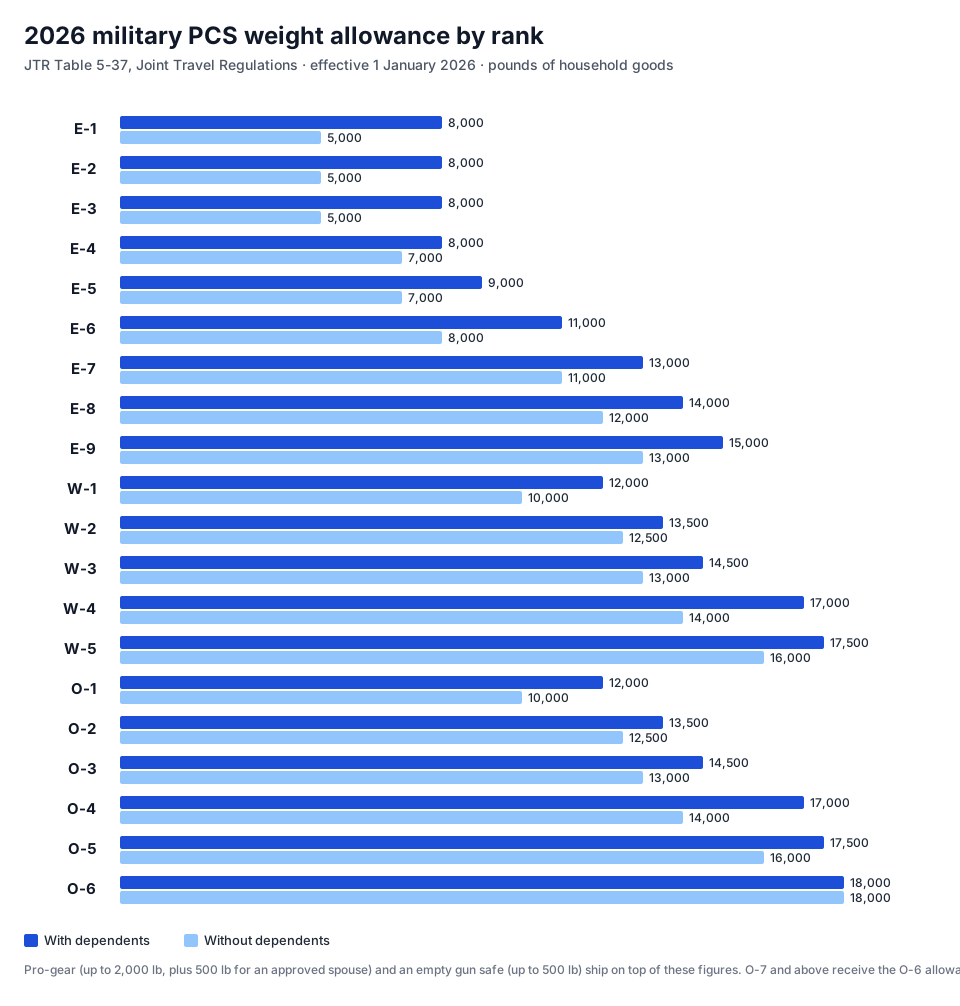
Weight allowances by pay grade — JTR Table 5-37
| Pay grade | With dependents | Without dependents |
|---|---|---|
| Service Academy Cadet or Midshipman | 0 lb | 350 lb |
| Aviation Cadet | 8,000 lb | 7,000 lb |
| E-1 | 8,000 lb | 5,000 lb |
| E-2 | 8,000 lb | 5,000 lb |
| E-3 | 8,000 lb | 5,000 lb |
| E-4 | 8,000 lb | 7,000 lb |
| E-5 | 9,000 lb | 7,000 lb |
| E-6 | 11,000 lb | 8,000 lb |
| E-7 | 13,000 lb | 11,000 lb |
| E-8 | 14,000 lb | 12,000 lb |
| E-9 | 15,000 lb | 13,000 lb |
| W-1 | 12,000 lb | 10,000 lb |
| W-2 | 13,500 lb | 12,500 lb |
| W-3 | 14,500 lb | 13,000 lb |
| W-4 | 17,000 lb | 14,000 lb |
| W-5 | 17,500 lb | 16,000 lb |
| Service Academy Graduate | 12,000 lb | 10,000 lb |
| O-1 | 12,000 lb | 10,000 lb |
| O-1E (Prior Enlisted) | 12,000 lb | 10,000 lb |
| O-2 | 13,500 lb | 12,500 lb |
| O-2E (Prior Enlisted) | 13,500 lb | 12,500 lb |
| O-3 | 14,500 lb | 13,000 lb |
| O-3E (Prior Enlisted) | 14,500 lb | 13,000 lb |
| O-4 | 17,000 lb | 14,000 lb |
| O-5 | 17,500 lb | 16,000 lb |
| O-6 | 18,000 lb | 18,000 lb |
Typical household goods weight by room
| Room | Typical weight |
|---|---|
| Living or family room | 1,500 lb |
| Bedroom | 1,000 lb |
| Dining room | 800 lb |
| Kitchen | 700 lb |
| Office or den | 800 lb |
| Garage, shed or workshop | 1,200 lb |
| Patio or outdoor furniture | 400 lb |
What 500 lb over costs an E-5 with dependents, by lane
| Lane | Distance | Government's shipment cost, estimated | Your share for 500 lb over |
|---|---|---|---|
| Fort Bragg, NC → Fort Campbell, KY | 617 mi | $7,410 ($5,557–$9,262) | $390 ($292–$487) |
| Fort Bragg, NC → Fort Hood, TX | 1,275 mi | $8,748 ($6,561–$10,935) | $460 ($345–$576) |
| Fort Drum, NY → Camp Pendleton, CA | 2,753 mi | $11,865 ($8,898–$14,831) | $624 ($468–$781) |
- PCS move cost calculator — what this weight is worth in DLA, MALT, per diem and PPM incentive
- TLE calculator — lodging between quarters
- 2026 PCS rates — DLA, MALT and per diem in one table
- How the shipment cost behind the excess-weight estimate is built
- Pro-gear and spouse pro-gear — the paperwork that keeps it outside the allowance
- Why a utility trailer comes out of the allowance instead of adding to it
- Filing a PPM claim, and the weigh tickets it needs
- Non-temporary storage — what the government pays for
- Base guides — BAH and housing at 260 installations
Common questions
What is the HHG weight allowance for an O-4 with dependents?
An O-4 with dependents is authorized 17,000 lb of household goods under JTR Table 5-37. Without dependents the same grade is authorized 14,000 lb. A W-4 receives the identical allowance — the warrant and commissioned scales meet at that grade.
Is the O-4 weight allowance 17,000 or 18,000 pounds?
17,000 lb, with dependents. 18,000 lb is the O-6 figure, and it is the highest allowance in JTR Table 5-37 — that grade receives it whether or not dependents relocate. The two are one grade apart and are often quoted interchangeably, but packing to the wrong one is the difference between an allowance and an overage you pay out of pocket.
How much can I ship at my rank?
Two things set the figure: your grade, and whether your dependents relocate with you. E-4 8,000 lb with dependents, 7,000 without; E-5 9,000 lb with dependents, 7,000 without; E-7 13,000 lb with dependents, 11,000 without; W-3 14,500 lb with dependents, 13,000 without; O-3 14,500 lb with dependents, 13,000 without; O-4 17,000 lb with dependents, 14,000 without; O-6 18,000 lb with dependents, 18,000 without. The full table below covers every grade from E-1 to O-6.
Does having dependents change my weight allowance?
Yes, for every grade except the highest. An E-5 goes from 7,000 lb to 9,000 lb once dependents relocate, and an E-7 from 11,000 lb to 13,000 lb. The allowance does not scale with how many dependents you have — one and four give the same figure. O-6 receives 18,000 lb either way.
What happens if I go over my weight allowance?
You pay the excess. The government moves your goods up to the authorized weight and bills you for everything above it, pro-rated across the whole shipment — so an overage is charged at the full commercial rate for those pounds, not a penalty on top. Weigh tickets from the origin and destination scales are what the final figure is computed from, which is why they are worth keeping.
Does professional gear count against my weight allowance?
No. Professional books, papers and equipment — PBP&E, JTR par. 051304 — is authorized on top of the figures in this table, not inside them, provided it is genuinely required for your duties and is weighed and listed separately on the inventory. A spouse's professional gear is authorized separately again. Gear that is not itemized at pack-out counts as ordinary household goods, so the paperwork is the entitlement.
How much can an E-6 ship?
11,000 lb with dependents and 8,000 lb without, under JTR Table 5-37. An E-5 is 9,000 and 7,000; an E-7 is 13,000 and 11,000. Pro-gear and an empty gun safe ship on top of the figure; unaccompanied baggage comes out of it.
Does a gun safe count against my weight allowance?
Not up to 500 lb. JTR par. 051304-C authorizes an empty gun safe in addition to the JTR Table 5-37 allowance, provided the allowance plus the safe does not exceed 18,000 lb, and provided it is declared at origin and documented under your Service's transportation procedures. A safe heavier than that counts against the allowance for the difference.
Is unaccompanied baggage on top of the weight allowance?
No. Unaccompanied baggage is part of the household-goods weight allowance (JTR par. 051403-A), so what you send ahead comes out of the same figure the main shipment is weighed against — par. 051401-A counts the allowance as the main shipment, the unaccompanied baggage and anything in storage, combined. What rides on top instead is pro-gear — up to 2,000 lb for the member and 500 lb for an approved spouse — along with required medical equipment and an empty gun safe (par. 051401-A-1).
What does going over the weight allowance cost?
The excess share of the shipment's cost. JTR par. 051306-D prorates the cost of the excess net weight on the cost of the total net weight transported, so 500 lb over on a 9,500 lb shipment is 5.3% of what the Government paid the carrier — at that lane's rate, not a flat rate per pound. The estimator on this page prices your origin and destination on the 400NG tariff and applies the rule, which is a dollar range rather than the "ask your transportation office" every other page gives.
Where do these weight allowances come from?
JTR Table 5-37 of the Joint Travel Regulations, published by the Per Diem, Travel and Transportation Allowance Committee, effective 1 January 2026. The allowances are set by grade and dependency status and apply to all six branches — Army, Navy, Air Force, Marine Corps, Space Force and Coast Guard. Weights are in pounds and describe the full PCS allowance.
Everything on this site
- Military Retirement Calculator — Pension under BRS, High-3 and CSB/REDUX, for active duty, Guard and Reserve
- VA Disability Calculator — Combined rating under 38 CFR §4.25, and the 2026 monthly payment
- PCS Per Diem Calculator — Travel per diem and MALT mileage for a PCS, driving or flying
- TLA Calculator — Temporary Lodging Allowance during an OCONUS PCS
- DLA Calculator — Dislocation Allowance by pay grade and dependency status
- OHA Calculator — Overseas Housing Allowance and MIHA
- Deployment Pay Calculator — What a deployment adds to your pay, including the tax exclusion
- SDP Calculator — Savings Deposit Program interest during a deployment
- Military Spouse Tax Wizard — MSRRA state residency and license portability
- VA Loan Calculator — Affordability, funding fee tier and monthly payment
- TSP Calculator — Thrift Savings Plan growth with BRS matching
- Military Pay Calculator — Base pay, BAH and BAS by rank — and the civilian salary that matches
- On-Base Savings Calculator — Commissary, Exchange and on-base fuel savings
- BAH Calculator — 2026 housing allowance by installation and paygrade
- All military pay and PCS calculators
- PCS guides — entitlements, DITY moves, orders and allowances
- Resources — official DoD PCS sources, moving vendors and vehicle shipping