DLA Calculator — Dislocation Allowance
Look up what Dislocation Allowance pays for your grade and household. DLA is a flat, non-taxable payment set by two inputs only — your pay grade on the date of the PCS, and whether authorized dependents actually relocate with you. Relocating is the test, not marriage: a family that stays at the old duty station draws the without-dependents rate. The rates effective 1 January 2026 run from $1,871 to $5,750 depending on grade and dependency, and Partial DLA is a flat $1,003 when a PCS is authorized but household goods are not shipped.
Rates last verified August 2026 against the published source tables.
Three moves pay no DLA at all, and each one surprises someone every cycle: a first-duty-station move with no dependents relocating pays nothing (JTR §050509-A) — a single member reporting to their first station receives no DLA, while the same member with a relocating family receives the full with-dependents rate; and separation and retirement moves pay nothing regardless of grade or dependents (JTR §050509), though household goods shipment, MALT and per diem still apply to the final move.
DLA requires no receipts and does not depend on what the move cost — it is paid on top of the move's other entitlements to acknowledge the costs nothing else reimburses. It is also not automatic in practice: it is typically paid through the finance office once the PCS is initiated, and following up beats waiting for it to appear on an LES.
Who is paid DLA, and who is not
Dislocation Allowance helps with the costs of setting up a household that nothing else reimburses. It is paid on a government-directed PCS, once per move and not more than once in a fiscal year. Two inputs set the amount: your pay grade on the effective date of the orders, and whether authorized dependents actually relocate. It needs no receipts and does not depend on what the move cost.
Moving twice in one fiscal year. Only one DLA is authorized in a fiscal year (JTR §050501-B), and the year is set by the date you depart the old duty station rather than the date the orders were cut (§050501-C). The limit carries nine exceptions, so a second move in the same year is not automatically unpaid: a partial DLA sits outside it entirely, and so do a second PCS the Service Secretary approves, a PCS to or from a Service-run course, an evacuation, a move ordered in wartime or a national emergency, orders that are amended, canceled or revoked, a BRAC move, and a change of home port or PDS for a unit. Moves in the same year that paid nothing are not counted against the limit either. If a second move is on the way, your finance office decides this one — the calculator prices a single move.
Three moves pay nothing. A first-duty-station move with no dependents relocating (JTR par. 050509) — an E-5 in that case is paid $0 rather than the $2,389 the same grade draws on a later move; a separation or retirement move, because a final move to a home of selection is not a government-directed PCS; and a move between quarters on the same installation with no change of duty station. The calculator applies all three, which is why it can answer $0 and say why.
"With dependents" means they move. It is not a marital status. A married member whose family stays behind draws the without-dependents rate — for an E-5 that is the difference between $3,548 and $2,389. If the family relocates but travels separately, the with-dependents rate still applies.
A family that follows later is deferred, not forfeited. JTR §050503-B pays the without-dependents rate when an authorized dependent does not move with you, and then pays "a DLA equal to the difference between the without-dependent rate and the with-dependent rate" if that dependent later joins you and travels at government expense. For an E-5 that second claim is $1,159, which brings the move up to the $3,548 the grade draws with dependents relocating. Two conditions ride on it: the without-dependents rate assumes government quarters are not assigned at the new PDS, and the later travel has to be at government expense rather than a move the family funds itself. Keep the orders and the first voucher — the second claim references them.
A first-duty-station move is the exception, and even it is not always final. That move pays nothing rather than the lower rate, so there is no difference to defer. What §050509-A withholds it for is the absence of a dependent moving "in connection with the PCS", and the paragraph puts no deadline on that move — §050503-A11 lists the first-PDS move among the cases a dependent's later travel can open up. A family that follows on the same orders is worth asking finance about rather than writing off.
A worked example
An E-5 with dependents relocating on a standard PCS is paid $3,548, effective 1 January 2026. The same member without dependents relocating is paid $2,389. An O-3 with dependents is paid $4,042. There is no proration for distance, no reduction for government quarters, and no adjustment for how much the move actually cost.
Partial DLA. A member ordered to occupy or vacate government quarters due to privatization, renovation or another reason for the government's convenience is paid a flat $1,003 under JTR §050508-A, whatever the grade and whether or not dependents are in the picture. It is a local-move payment, not a smaller PCS one: §050508-A-2 excludes a PCS, a move between privatized units, a move between barracks rooms, and a move you chose.
Flag and general officers. O-7 and above are paid $6,386 with dependents and $5,187 without — one rate across all four grades, which is why the table stops naming them individually.
Where the rule comes from
JTR Chapter 5, par. 0505 authorizes DLA and par. 050509 lists the situations that do not. The rates themselves are published by the Per Diem, Travel and Transportation Allowance Committee and take effect 1 January 2026; this site holds the published table rather than a transcription of a summary of it, and the changelog records the day it moved.
It is not taxable. DLA is a non-taxable allowance, like BAH and BAS. It does not appear on a W-2 and nothing is withheld from it — which is the opposite of the PPM incentive, where 22% federal supplemental withholding applies before the money arrives.
It is not reimbursement, and it is the same in every branch. The move's actual costs are covered elsewhere — by the household goods shipment, by MALT and by travel per diem — and DLA sits on top of all three for the costs none of them reach: deposits, utility connections, the things a household needs twice. Because the authority is the JTR rather than a service regulation, the rate is identical for the Army, Navy, Air Force, Marine Corps, Space Force and Coast Guard; a figure that differs by branch is a dependency determination, not a different table.
How it is claimed
DLA is processed by your finance office against the PCS travel voucher, and it can often be advanced before the move — worth asking about if cash flow before pack-out is the problem. Processing times vary by installation; keep a record of the day you submitted and who you spoke to, and follow up rather than assuming it will appear on the next LES.
The mistake that costs money
Assuming it is automatic. DLA is an entitlement, not an automatic payment. A voucher that never gets filed pays nothing, and nobody chases it on your behalf — the payment follows the claim, and the claim follows you.
Not checking the amount against your grade. A dependency determination that does not reflect who actually relocated pays the wrong rate. Check what lands against your grade's row above: a difference of exactly the with-dependents gap means the determination, not the arithmetic, is what to query with finance.
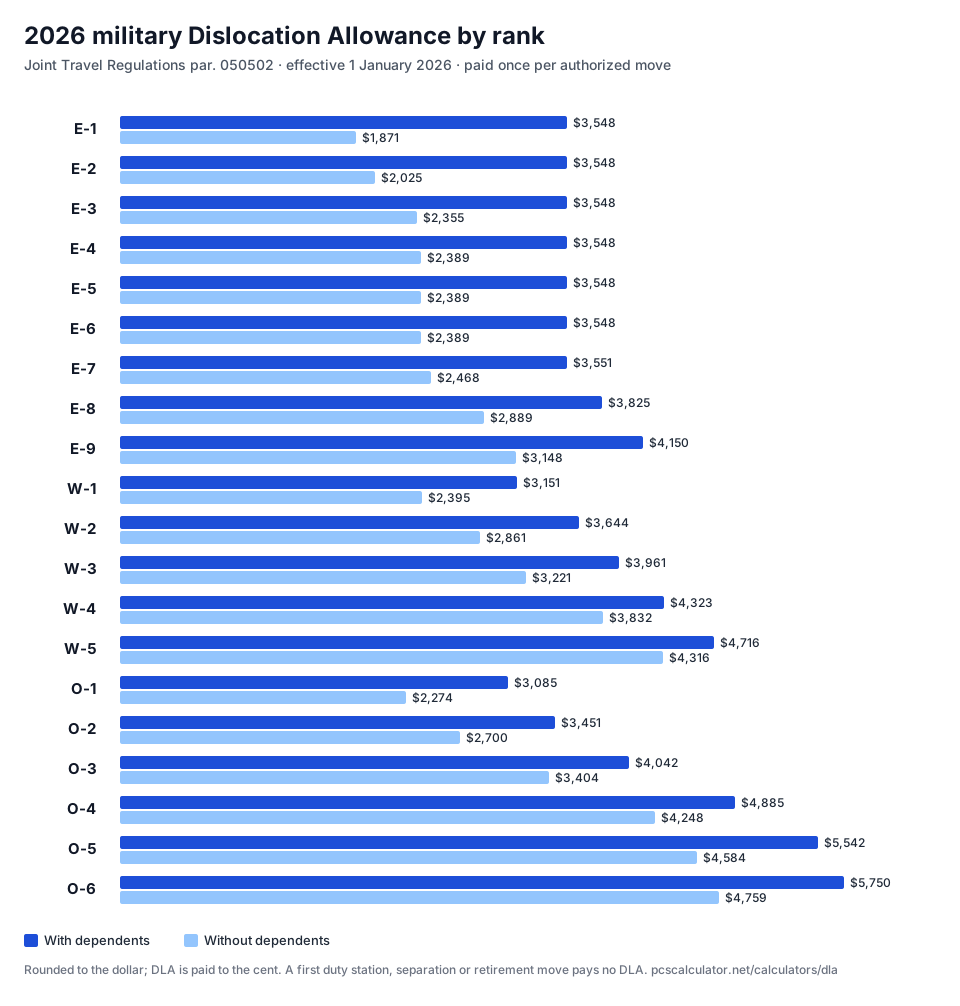
Dislocation Allowance by pay grade — effective 1 January 2026
| Pay grade | With dependents | Without dependents |
|---|---|---|
| Service Academy Cadet or Midshipman | $3,548 | $1,871 |
| Aviation Cadet | $3,548 | $1,871 |
| E-1 | $3,548 | $1,871 |
| E-2 | $3,548 | $2,025 |
| E-3 | $3,548 | $2,355 |
| E-4 | $3,548 | $2,389 |
| E-5 | $3,548 | $2,389 |
| E-6 | $3,548 | $2,389 |
| E-7 | $3,551 | $2,468 |
| E-8 | $3,825 | $2,889 |
| E-9 | $4,150 | $3,148 |
| W-1 | $3,151 | $2,395 |
| W-2 | $3,644 | $2,861 |
| W-3 | $3,961 | $3,221 |
| W-4 | $4,323 | $3,832 |
| W-5 | $4,716 | $4,316 |
| Service Academy Graduate | $3,085 | $2,274 |
| O-1 | $3,085 | $2,274 |
| O-1E (Prior Enlisted) | $3,621 | $2,687 |
| O-2 | $3,451 | $2,700 |
| O-2E (Prior Enlisted) | $3,919 | $3,125 |
| O-3 | $4,042 | $3,404 |
| O-3E (Prior Enlisted) | $4,344 | $3,676 |
| O-4 | $4,885 | $4,248 |
| O-5 | $5,542 | $4,584 |
| O-6 | $5,750 | $4,759 |
- PCS move cost calculator — DLA, MALT, per diem and PPM incentive together
- 2026 PCS rates — the full DLA table, every grade
- TLE calculator — temporary lodging on the same orders
- All military pay and PCS calculators
Common questions
How much is DLA in 2026?
Between $1,871 to $5,750, effective 1 January 2026. Two things set your rate: your pay grade on the date of your PCS, and whether authorized dependents actually relocate with you — being married is not enough if your family stays at the old duty station. If they stay behind you are not simply out the difference: you draw the without-dependents rate now and claim the rest when they join you and travel at government expense (JTR §050503-B). Every grade's exact figure is in the 2026 rates tables, and the calculator above answers for your grade directly.
When is DLA not paid?
Three cases, all under JTR §050509: a first-duty-station move with no dependents relocating (a single member reporting to their first PDS receives nothing); separation; and retirement — the final move out of the military generates no DLA regardless of grade or dependents, though HHG shipment, MALT and per diem still apply. Moving between housing units on the same installation without a change of duty station also pays nothing. See the separation and retirement move guide for what the final move does pay.
Do I need receipts for DLA, and is it taxable?
No receipts, and no tax. DLA is a flat allowance based on your grade and dependency status — it is not tied to what the move actually cost you, and like BAH and BAS it is a non-taxable allowance, so you receive the full amount. It is typically paid through your finance office after the PCS is initiated; follow up rather than assuming it will appear in your next LES. PCS taxes explained covers which PCS money is and is not taxed.
What is Partial DLA?
A flat $1,003, the same for every grade and either dependency status. JTR §050508-A-1 says a member ordered to occupy or vacate government quarters due to privatization, renovation or another reason for the government's convenience must be paid one, and no PCS order is involved: §050508-A-2 rules out a PCS, a move between privatized units, a move between barracks rooms, a move you chose, and a local move on separation or retirement. Privatized housing is not government quarters (JTR Appendix A), so a move between privatized housing and a civilian rental does not qualify either.
What is the 2026 DLA rate for an E-5 with dependents?
$3,548, effective 1 January 2026, when authorized dependents relocate on the move. The same E-5 reporting without dependents relocating draws $2,389. An O-3 with dependents draws $4,042. The calculator above answers for any grade, and the table on this page carries all of them.
Is DLA the same in every branch?
Yes. DLA is authorized by the Joint Travel Regulations, which govern the Army, Navy, Air Force, Marine Corps, Space Force and Coast Guard alike, so the rate for a grade is identical whichever service pays it. Two members of the same grade being paid different amounts is a dependency determination or a partial-DLA scenario, not a different table.
Does the PCS calculator already include DLA?
Yes — the PCS move cost calculator computes DLA alongside MALT, per diem and the PPM incentive, and applies the same scenario rules automatically. Use this page when DLA is the number you need on its own; use the full calculator when you are budgeting the whole move.
Everything on this site
- Military Retirement Calculator — Pension under BRS, High-3 and CSB/REDUX, for active duty, Guard and Reserve
- VA Disability Calculator — Combined rating under 38 CFR §4.25, and the 2026 monthly payment
- PCS Per Diem Calculator — Travel per diem and MALT mileage for a PCS, driving or flying
- TLA Calculator — Temporary Lodging Allowance during an OCONUS PCS
- OHA Calculator — Overseas Housing Allowance and MIHA
- Deployment Pay Calculator — What a deployment adds to your pay, including the tax exclusion
- SDP Calculator — Savings Deposit Program interest during a deployment
- Military Spouse Tax Wizard — MSRRA state residency and license portability
- VA Loan Calculator — Affordability, funding fee tier and monthly payment
- TSP Calculator — Thrift Savings Plan growth with BRS matching
- Military Pay Calculator — Base pay, BAH and BAS by rank — and the civilian salary that matches
- On-Base Savings Calculator — Commissary, Exchange and on-base fuel savings
- BAH Calculator — 2026 housing allowance by installation and paygrade
- Weight Allowance Chart — Household goods weight allowances by pay grade
- Military Base Guides — Housing, BAH and OHA at 260 installations
- PCS guides — entitlements, DITY moves, orders and allowances
- Resources — official DoD PCS sources, moving vendors and vehicle shipping